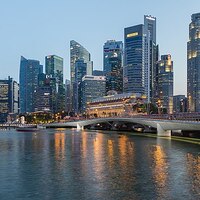


SINGAPORE: A late-year surge in manufacturing and technology demand powered Singapore's economy to its strongest annual expansion in four years, capping what economists described as an unexpectedly strong performance driven in large part by the global artificial intelligence boom.
Singapore's economy grew 5.7 percent in the fourth quarter from a year earlier, lifting full-year GDP growth for 2025 to 4.8 percent, preliminary government data showed on January 2. That marked the fastest annual increase since 2021 and came well above the trade ministry's November forecast of "around 4.0 percent," which itself had been raised from an earlier range of 1.5 percent to 2.5 percent.
Economists had expected annual growth of 3.7 percent in the fourth quarter.
"Growth during the quarter was largely driven by output expansions in the biomedical manufacturing and electronics clusters," Singapore's Ministry of Trade and Industry said in a release, adding that gains in the tech sector were supported by "sustained demand for AI-related semiconductors, servers, and server-related products."
The upbeat data highlight how Singapore has benefited from the rapid global rollout of AI infrastructure, particularly demand for chips and high-end electronics, even as many economies grapple with slowing trade and higher borrowing costs.
OCBC economist Selena Ling described 2025 as a "stunning year" for the city-state, which posted 4.4 percent growth in 2024.
"This impressive outcome marked a significant upward revision from earlier forecasts that had projected slower growth and reflected a resilient global economy and export demand, some front-loading ahead of reciprocal tariff pressures and also broad-based gains across key sectors," Ling said.
On a quarter-on-quarter, seasonally adjusted basis, GDP expanded 1.9 percent from the third quarter, according to the advance estimates.
In his New Year message on December 31, Prime Minister Lawrence Wong cautioned that sustaining last year's pace of growth would be challenging. He attributed the stronger-than-expected outcome in 2025 partly to U.S. tariffs being imposed later and at lower levels than initially expected, as well as the surge in AI-related demand for semiconductors and electronics.
Friday's release did not include official forecasts for 2026. The trade ministry has previously projected GDP growth this year in a range of 1.0 percent to 3.0 percent. OCBC's Ling expects growth of about two percent year-on-year in 2026.
At its October review, the Monetary Authority of Singapore left monetary policy unchanged, citing resilient growth despite risks from U.S. tariffs. The central bank's next policy review is due later this month.
Singapore's exports to the United States are currently subject to a 10 percent tariff, lower than those imposed on several Southeast Asian neighbours. However, sector-specific levies remain a concern, including a 100 percent tariff on branded drugs.
Broader sectoral tariffs could weigh on demand for key Singapore exports, including semiconductors, consumer electronics, and pharmaceutical goods. The central bank has previously said those three sectors together account for about 40 percent of Singapore's exports to the United States.